


Commercial -
Income buys time for St Albans redevelopment site
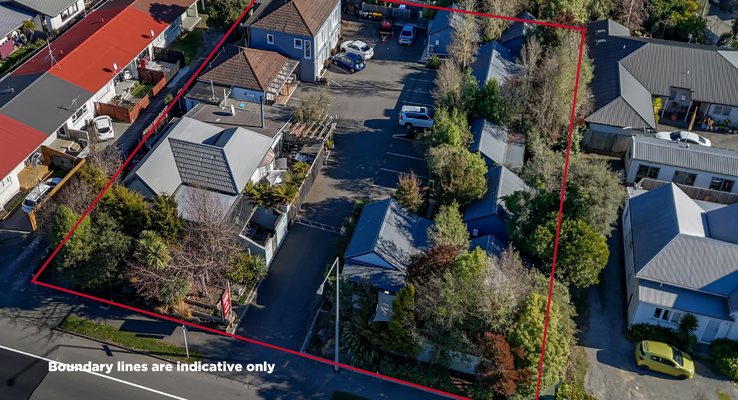
A substantial St Albans landholding combining passive income with several potential redevelopment pathways has been placed on the market as Christchurch directs more housing growth towards established neighbourhoods, Bayleys brokers say.
Bayleys South Island Capital Markets director Jesse Paenga, together with colleague William Wallace, is marketing the property at 63 Cranford Street for sale by deadline, closing at 4:00 pm on Thursday, 10th September 2026 (unless sold prior).
The offering comprises a regular-shaped 2,094sqm (more or less) freehold site with approximately 666sqm of improvements and prominent frontage to Cranford Street.
Its existing accommodation includes a character villa with origins in 1914, six concrete-block units, six self-contained studio cottages and a transportable building containing two further self-contained studios.
Paenga says the configuration provides income across multiple accommodation formats, giving a purchaser the ability to hold the property while assessing its longer-term use.
“Income is critical as it changes the development equation. The next purchaser needn’t pursue an immediate scheme simply to justify the landholding; they can investigate design, consenting, construction costs and the most appropriate market segment while the existing use continues to generate cash flow.”
Several of the newer structures are relocatable and depreciable, potentially allowing them to be removed or repositioned as plans progress.
The site is zoned Medium Density Residential, a framework intended to accommodate greater housing choice near centres, amenities and transport routes. It provides for buildings generally up to 11 metres, with an additional metre available for qualifying roof forms, subject to applicable standards.
Up to three homes can be developed as a permitted activity where all relevant requirements are met. Proposals for four or more units require resource consent and urban design assessment, meaning the site’s scale may support investigation of a more comprehensive scheme rather than limiting purchasers to the permitted baseline.
Bayleys South Island Commercial general manager, William Wallace, says potential responses could include terraced housing, apartments or a boutique townhouse development. Retirement or assisted-living concepts may also warrant investigation, subject in every case to planning, design, infrastructure and consenting requirements.
“Christchurch’s growth story increasingly favours well-located intensification, but zoning alone does not make every parcel equally useful,” he says.
“Development outcomes are also influenced by shape, frontage, access, the surrounding amenity network and the capacity to assemble an efficient project. At Cranford Street, those characteristics are brought together in one landholding.”
The property lies minutes from central Christchurch, with connections via Cranford Street and Bealey Avenue to the CBD and wider arterial network. Merivale Village, Hagley Park, Christchurch Hospital, schools, hospitality and public transport are also nearby.
Wallace says the region’s demographic change adds another dimension to the range of possible uses. “Greater Christchurch’s housing capacity assessment anticipates strong growth in one-person and couple-only households as the population ages, supporting demand for a broader mix of housing types.”
“For investors, the proposition is income plus control over what happens next. For developers, it is the ability to test several end uses in an established city fringe market before committing capital to one delivery strategy.”
Contact us


